
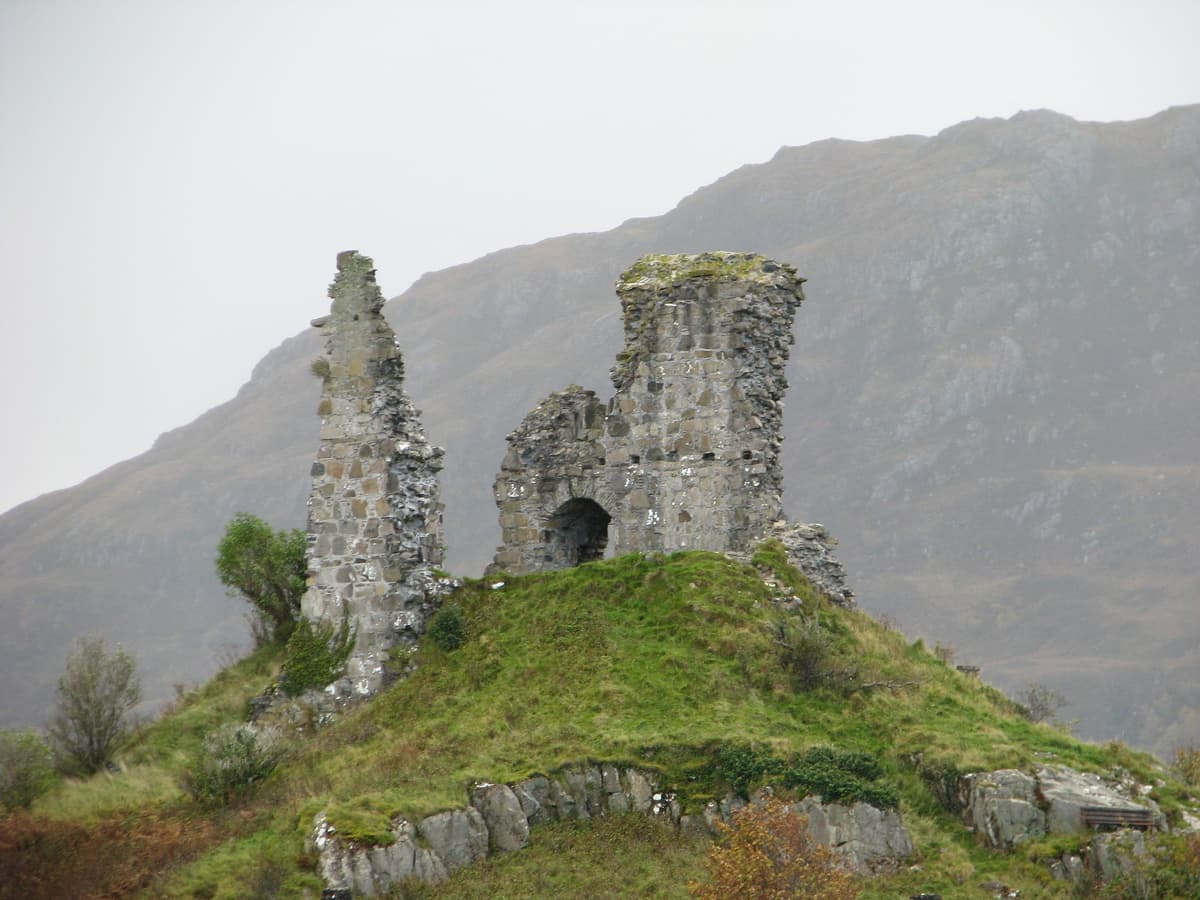
Nestled along the rugged coastline of Scotland, Caisteal Maol, also known as Castle Moil, stands as a silent sentinel, whispering tales of centuries gone by. This ruined coastal fortress, perched near the village of Kyleakin on the Isle of Skye, carries a rich history that mirrors the dynamic tapestry of Scottish heritage.
Origins and Early Construction:
The castle's strategic location at the entrance to Loch Alsh allowed it to control vital sea routes and served as a defensive bastion against potential invaders. In fact, as early as the 10th century the MacKinnon clan ran a heavy chain across the sound, stopping shipping vessels from passing without paying a toll.
The original structure was likely a simple fortification, but its significance in the local landscape quickly grew. The current structure's history can be traced back to the 15th century when it was constructed as a stronghold by Clan MacKinnon, though it's simply the most recent of a long line of structures on that particular hill.
Clan MacKinnon and the Fortress's Heyday:
During the medieval period, Clan MacKinnon held sway over the region, and Caisteal Maol became a symbol of their power and influence. The castle underwent expansions and renovations, evolving into a more substantial fortress with defensive features such as walls, towers, and a keep. Its coastal perch not only provided defensive advantages but also offered panoramic views of the surrounding waters.
Strategic Importance and Military Significance:
The castle's strategic location made it a crucial outpost in the ongoing conflicts that characterized medieval Scotland. Its proximity to the Isle of Skye's mainland and the nearby Kyle of Lochalsh made Caisteal Maol a key player in controlling access to these waters. It was also at Caisteal Maol that King Haakon IV of Norway was thought to have assembled his fleet of longships before the Battle of Largs in 1263.
Transformation and Decline:
Over the centuries, Caisteal Maol underwent transformations to adapt to changing military tactics and needs. The castle's role shifted from a purely defensive structure to a residence for the local clan chiefs. As peace settled over the region, the military significance of the fortress diminished.
However, like many historic sites, Caisteal Maol faced a period of decline. By the 18th century, the castle had fallen into disrepair, its once-mighty walls weathered by time and the elements. The abandonment of the fortress marked the end of an era, and Caisteal Maol became a poignant reminder of Scotland's turbulent past.
Preservation and Visitor Experience:
In recent times, efforts have been made to preserve Caisteal Maol and offer visitors a glimpse into its storied history. While the castle remains in a semi-ruined state, the remnants of its walls and towers evoke a sense of medieval grandeur. The site allows visitors to explore the castle's layout, wander through its atmospheric chambers, and imagine the lives of those who once called it home.
The location of Caisteal Maol also provides stunning views of the surrounding landscape, making it a popular destination for history enthusiasts, photographers, and those seeking a connection to Scotland's past. The site's ability to transport visitors back in time, combined with its coastal beauty, makes it a unique and memorable stop on the historical trail of the Isle of Skye.
Caisteal Maol, with its weathered stones and commanding presence on the Isle of Skye's coastline, encapsulates the spirit of medieval Scotland. From its origins as a strategic fortress to its role as a clan stronghold and eventual decline, the castle's history reflects the ebb and flow of power and the enduring legacy of the clans that once shaped the region. Today, as visitors explore the atmospheric ruins, Caisteal Maol stands as a testament to Scotland's past, inviting us to unravel the stories embedded in its ancient stones and coastal vistas.