In the tumultuous pages of Scottish history, the late-13th century stands as a crucible of resistance and resilience, with William Wallace at its forefront. We discussed Wallace - and his enduring legacy - with the Scottish History Podcast host Owen Innes in just our second episode.
Yet, the narrative of this era is not solely defined by the exploits of one man. Several contemporaries of Wallace played pivotal roles, contributing to the tapestry of Scotland's fight for independence.
-
Andrew de Moray: The Strategist Andrew de Moray, a nobleman of considerable standing, joined forces with Wallace in their shared vision of a free Scotland. Moray was instrumental in the early victories against English forces, including the Battle of Stirling Bridge in 1297. His strategic acumen and unwavering commitment to the cause made him a key ally to Wallace. Tragically, Moray succumbed to wounds sustained in battle at Stirling, but his legacy endured as a symbol of unity and resistance.
-
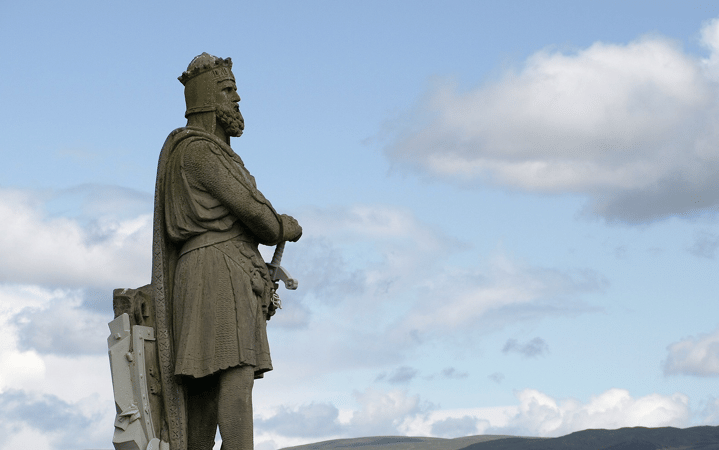
Robert the Bruce: The Future King A figure intricately woven into Scotland's history is Robert the Bruce, a noble with a strong claim to the Scottish throne and the drive to make it a reality, Bruce embraced the cause for Scottish independence, emerging as a prominent leader after Wallace's capture. His resilience and strategic brilliance would later lead to the famous victory at the Battle of Bannockburn in 1314, solidifying his place as King Robert I of Scotland. Despite a failed invasion of Ireland post-Bannockburn, he would go down as one of Scotland's greatest leaders.
Listen to our episode with Owen Innes about William Wallace:
John Comyn: The Complex Adversary John Comyn, known as the Red Comyn, was a formidable noble and a contender for the Scottish throne. His rivalry with Robert the Bruce escalated to a fatal confrontation in the church of the Greyfriars at Dumfries in 1306, a shocking event that made Bruce's pursuit of legitimacy more challenging in the years to come. Despite being remembered most as Bruce's adversary, he was a Guardian of Scotland and for a time commanded the defence of Scotland against English attacks.
-
Sir William de Lamberton: The Church's Guardian As Bishop of St. Andrews, Sir William Lamberton played a unique role in the struggle for Scottish independence. Lamberton supported Wallace and later Robert the Bruce, offering moral and strategic guidance. His position within the Church added a layer of legitimacy to the Scottish cause, highlighting the multifaceted nature of the fight against English domination. His support of Robert and involvement in the Wars of Independence led to his excommunication from the Catholic Church. Lamberton died just 18 days after England officially recognized that Scotland as a fully sovereign, independent state.
-
Sir Simon Fraser: Agent of Chaos Sir Simon Fraser fought for both sides in the Scottish Wars of Independence. Initially, he opposed King Edward I's efforts to usurp the Scottish throne, but after being captured at Dunbar he became a knight in Edward's entourage and rode into battle at Falkirk on the English side. He then re-joined the Scots in mid-1301, rejoined the English effort in 1305, and then fought on the Scottish side at the Battle of Methven in 1306. Is your head spinning yet? He was, following Methven, captured and executed, with his head displayed on a spike alongside Wallace's on London Bridge.
The era of William Wallace was marked by many courageous individuals, each contributing to the story of Scotland's quest for independence. From allies like Andrew de Moray to adversaries like John Comyn, and eventual successors like Robert the Bruce, these figures shaped the destiny of a nation. Their collective efforts and sacrifices underscore the complexity and richness of Scotland's historical struggle for freedom during this transformative period.