
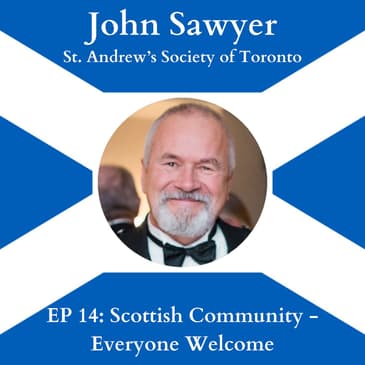
If you're a listener of 63 Percent Scottish then I have to imagine you have *some* interest in Scotland, Scottish things or the like. If you don't live in Scotland - and most people with Scottish heritage don't! - and even if you don't have Scottish genetic heritage, you may be interested in joining a Scottish Community.
Scottish Societies and St. Andrew's Societies can be found all over Canada, the United States, Australia and New Zealand, and they provide unique opportunities to connect with Scottish culture, as well as connecting with other people who love everything Scotland.
To tell us more about Scottish communities, we're talking to John Sawyer - the President of the St. Andrew's Society of Toronto. We discuss:
- The relative unimportance of Scottish genetics
- His own entry-point to Scottish culture
- What a St. Andrew's Society is and how he found himself leading one
- The benefits of joining a St. Andrew's Society
Want to join a Scottish community? Here are some groups you could check out:
- St. Andrew's Society of Toronto
- Scottish Society of Ottawa
- St. Andrew's Society of Winnipeg
- St. Andrew's Society of Los Angeles
- Singapore St. Andrew's Society
- St. Andrew's Society of the State of New York
- Chicago Scots
- Clans and Scottish Societies of Canada
Have thoughts? Connect with 63 Percent Scottish on Twitter, Facebook or Instagram or contact us at 63percentscottish.com.
Music by RomanSenykMusic from Pixabay.
[00:00:00] This is 63% Scottish, a Scotland Appreciation Podcast. Food or History. Of course, this entire podcast is built upon the surprise discovery of my rather strong Scottish genetics, but in reality you could be 0% Scottish and want to learn about Scotland.
[00:00:44] In that first episode I was speaking to Dr. Kevin James, the Scottish Studies Foundation chair at the University of Gwelf, who noted that he began studying Scottish history long before he knew he had any Scottish heritage.
[00:00:56] In fact, he joked that when he became the Scottish Studies Foundation chair, his genetics were unknown to him so it was a bit of a relief to find that he did have Scottish blood coursing through his veins. What's my point?
[00:01:09] Well, you can become a renowned Scottish historian without being 100% Scottish. You can become a renowned bagpiper without being 100% Scottish. You can become a whisky condosaur without being 100% Scottish. You can become a fluent, gollick speaker. Unlike most scots I might add without being 100% Scottish.
[00:01:29] You can even become the leader of a Scottish community without being 100% Scottish. I know that the vast majority of our listeners aren't from Scotland so I hope that resonates. You can be 5% or 22% or 98% Scottish and be as curious as I am about everything Scotland has to offer.
[00:01:48] And that leads me to my guest, John Sawyer. John is the president of the San Andrew Society of Toronto. Founded in 1836 the society is almost definitely one of the largest such groups in North America but John is not 100% Scottish.
[00:02:05] In fact, in our earliest correspondence he noted that he celebrates his, and I quote here, Scottishness out of pride and preference rather than weight of DNA which I think is a poetic and beautiful notion. I've asked John to speak with me about a few things in this episode.
[00:02:23] First, what is it that attracts him to Scottish culture? What has he found in the St Andrew Society? Second, what does the San Andrew Society offer to people with or without Scottish heritage in Toronto?
[00:02:38] There are St Andrew societies or Scottish societies more broadly, all across Canada, the United States, Australia and New Zealand. And my hope is that hearing a bit about them might encourage you to take your first steps toward joining your own Scottish community. Enjoy the conversation.
[00:03:05] When we first trade at emails, you made it clear to me right away that you were far from 100% Scottish so let's just clear the air for those listening at home. What sort of genetic heritage do you have?
[00:03:17] All right, by weight of DNA I think I committed at 27% Scottish. Okay. My mother was data. She was born a Denmark. So it's a no particular surprise that fully half of my DNA is Scandinavian. Now, where the Scandinavian and the Scottish interconnect, I don't think I can necessarily
[00:03:41] track that part. And the rest is rounded out with English and Irish. Yeah, Scandinavian really does muddy those waters a little bit because I mean, Scotland, Scotland, Ireland, north of England. I mean, there's a lot of Scandinavian blood there to begin with.
[00:04:00] Well, hey, I love the flag of Shetland. I mean, you have to be one of those people. Joyce, the television show, Shetland. Of course, the flag is kind of a combination of the north flags with the cross's vertical and horizontal. Was a blue background.
[00:04:23] And you know, I go figure. And we had we had Kanya Kmaqlaud, the Heberdeen Baker on the show quite a while ago now. I think and he was talking about this with his cookbooks because he, you know, he's been
[00:04:37] cookbooks and they have sections on on north baking, you know, because he's like he's from the Isle of Lewis. He's like the connection to the north is almost as as strong as it is to Scotland for a lot of people there. So so that makes sense.
[00:04:53] Okay, let's I think that's that's a that's a that's a passable grade rate. That not it doesn't well, hey, I went 50% is already. It's already booked. I'm not a bad, but the thing is, you know, I mean like most multi-generational Canadians.
[00:05:13] We are often the mixture of cultures and nationalities as it may cases as well as races. And if we kind of reflect on our roots and perhaps try to connect with our heritage.
[00:05:26] We have to happen, you know, we as often as not we have to pick a lane. With these are going to celebrate. And, you know, as I've said to you, I chose to make the connection with the Scottish part of it.
[00:05:40] Yeah, of course this was made easier with the spouse of Scottish roots or broad and deep. She handles from Prince Edward Island 40% of the population, P.E.I. is of Scottish ancestry. And one of her parents was in the Kay and the others in the queue.
[00:05:57] Her ancestors were among the first to settle the island in the 1760s. In terms of Scottish DNA, she kind of up the family average. Yeah. That's it's you know, this is something you and I right before we started recording. We're talking about Dr. Kevin James.
[00:06:14] It was the first guest here and he's he's someone who has a close association with the Toronto Sanders Society. And he talked about this a lot about just not really necessarily caring about the genetic heritage piece because you get to make a lot of choices in life.
[00:06:31] And as you said, we're all a combination of a lot of different things for the most part. But it also shouldn't stop you from being that you're not 100% of anything shouldn't stop you from being interested.
[00:06:44] And you know, so it's it's no matter what your background is I think if you're interested in Scotland, it's you know, it's an opportunity for you to learn about Scotland. Yes. And that's what the Sanders Society is. So that's so we'll get to that point though.
[00:07:01] So you mentioned this just a second ago, I you know, I spent about three minutes in the introduction talking about how little importance we should place on genetic heritage.
[00:07:09] So the far more interesting question is how you became enamored with Scottish culture and so where do your love of Scotland start.
[00:07:19] You know, actually, the thing that's ironic about it was my Danish mother really that triggered the interest she'd been a fan of Scottish culture herself love bag pipes, highland games.
[00:07:34] And I was like, you know, rather than I am and kills us with expressed an interest at the time. Interesting. She tried to get me to join a quite man when I was young and we're gratably I didn't jump at the chance kids often. Yeah.
[00:07:52] But it was an interest that that you know, I kind of pursued and indulged for much my life. Two things. I think that relatively easy. I think style of punches way about it's weight when it comes to cultural like odds.
[00:08:09] I mean from chart and the kills whiskey the hang is bag pipes, the burns and not us forget all those highland games that go on certainly in this neck of the woods all over the province.
[00:08:25] And so, some of these abroad, you know, they're broadly exploited and identified with Scotland. I mean, what country of seven million people has that kind of cultural impact on global basis. I go to define it. There's not really anybody else that does it quite as well in Scotland.
[00:08:44] And then also makes it as a consequence. It makes it whole lot easier to participate in things Scottish because they're here. And they're very tangible and very tangible way. And I think the other thing is the degree to which Scots have been from skating, this re-enculture. Big influence.
[00:09:04] I didn't even mention the military influence. My Ken has got more military and kills. Then Scotland was. And you look at who's participating. Well, guess what? It's as diverse as their population. And there's all these men and women. Kilted. And you know, it's become part of their heritage.
[00:09:35] Yes. Even if it's primarily the military part of it. I guess that, you know, I think that has made it certainly has made it easier for me. And I think it makes it easier for anybody that finds a fascination in it to participate.
[00:09:57] And to learn about Scottish culture and Scottish influence. God, I was reading an article today, I've heard of this weekend in the middle of Mayle. And they were talking about George Brown. And his influence.
[00:10:15] Now, they didn't have to mention the passing that he twice been president of this in Andrew Society of Toronto. And what impact he had in that regard, looking after Scots were recent immigrants to the city. But hey, father and confederation, the founder of Canada's National Newspaper.
[00:10:37] And a politician went ahead with the Australian-Amel Donald. Lots of influence. But the Scott, as I said, the Scots have had such a big impact on our history and culture. Yeah, it's, I mean, you mentioned Sergian McDonald there.
[00:10:56] I mean, yeah, you go back and, and it's almost, it's almost every major. It's either a French, something that's historical event is either a French event or there's a couple of Scottish names at the top of the bill in Ontario for sure. So I'll tell you right now.
[00:11:18] So this is something people with what's in the show would know that I love history, obviously. But my gateway into embracing a culture's food.
[00:11:25] And I've actually talked about this on this podcast before about going to Iceland and being absolutely broken feeling like I kind of wasted the opportunity because it couldn't afford any of the food. Because it's incredibly expensive. This was a year ago and I was a missed opportunity.
[00:11:44] But when I, you know, the moment I realized that I had Scottish heritage, I started looking up what kind of whiskey I should be trying first. And convinced my mother who is very English, but also, but genetically very Scottish to try cooking some simple Scottish recipes with me.
[00:12:05] Currently drinking a going kinshi whiskey as we speak because that's that always gets me into the mood to talk with a Scotland.
[00:12:15] What, what is it about Scottish culture that has hooked you in? Like what, what is, is there anything that you can identify, say I love this. This is the thing that gets me keeps me coming back and could be music. It could be history. It could be maybe your substantial whiskey kind of sore.
[00:12:32] Yes, yes, yes, yes. Is there something specific though is there? Oh, hey, look, I kind of get the, I understand the effect of food and food and drink.
[00:12:47] And I think I think probably you know, one trigger was when my, a current wife bought me a formal kill to and we did I ended up getting married killed it.
[00:13:14] And enjoying several chaplains on kills and highland where I joined a group that met met monthly and local local public killed it. Just as a reason to get dressed up in highland where the kilth on fall absolutely absolutely good there was good company and,
[00:13:43] you know, you're going to go for a pot of drinking a pot. Doing it with a bunch of friends with a common interest is that it's good or reason was, it's good or reason is any.
[00:13:55] But I think the thing that was probably most significant was the same end as Sheridan Ball and, why do I start going to early days and early days for us not for the ball. That we got it a long time ago.
[00:14:18] Yeah, and it was you know, on the inside of my house it was a great opportunity get dressed up in highland formal where and go out and then go out and party.
[00:14:32] And the ball was and a lot of appeal and it was for us it is almost like our new year celebration was close enough. But we weren't getting dressed up in formal where and going out and celebrating new years so let's do it on say an Andrew stay.
[00:14:49] Yeah. And it's and it's the one those events that may as such is the ball we've got dance practices as well.
[00:14:58] And we met a lot of great folks and you know, even if it was just the once a year and we got together from the or the five times here we got together for the football.
[00:15:13] And it was a lot of fun and supporting worthy cause and it's as good as it gets and the society has a whole lot of traditions and activities that keep us on the keep us engaged.
[00:15:27] So I you know, as I said, the killed and the same end or society. We're kind of the glue. Yeah, they were the gateways and there are things that so we can't go back to.
[00:15:42] And so you met you we've been talking about the same Andrew society and I think that I'm perfect time to kind of to ask you went when and how you got involved with it.
[00:15:52] And kind of what were your first impressions as someone who is kind of just coming in contact with it. Well, as I said, I did he's into it. I've been going to the charity ball for the whole.
[00:16:05] It's probably eight years before somebody finally said, well, why don't you just join society. Because surprisingly, a lot of the people that come through that comes in the ball don't actually belong to society as well. And I said, well, okay, sure. All volunteer.
[00:16:28] Yeah, there's always that slippery slope, of course. Yeah. And because we are a volunteer organization, we don't have any paid staff. I mean, it's literally the directors and volunteers that run the organization,
[00:16:45] but all the events, choosing the lower funding to, you know, the charitable groups that we support. And so we need help. And I got a telling, yeah, great group of great group of individuals. I talented and interesting and I've enjoyed working with it.
[00:17:11] So I'm going from, you know, volunteering and then being on the, getting invited on the board. Sharing a number of different activities on the board and the last year, I was selected to the press.
[00:17:28] And I think I'm in the 1930 press, I think there's some kind of a counter. Yeah. I might ask you after this, we don't have to cover this at this exact moment. But I'd love to get a brief list at some point of some of the other presence.
[00:17:43] You know, because I know that there are a fair number of fairly prominent people on that list. Yes. And you're part of that. Yeah, I've heard it along with you. Well, it is. You know, I mean, that's certainly that's part of what's happening, but bigger in the organization.
[00:18:02] It's been around for 186 years older than the country. Yeah. You know, and that wasn't our first press of the day that was involved in building the country. You know, so yeah, we've had a long influence. I mean, just belonging to anything that's been around that long.
[00:18:25] And it's fascinating. It's fascinating. I mean, do I have to enjoy this? Yeah. It's the best on paid job, I've ever had. But it's, yeah. You know, we had, we just, we were doing our Christmas. First up, opportunity we had to get family together yesterday.
[00:18:55] And sitting in our dining room is the clock. Now, it's one of the traditions that's in society. It's at this clock. It goes from president to president. Interesting. And it has for over a hundred years. Now, the clock itself goes back to, as far as we know,
[00:19:19] the earth, the youngest it is, goes back to 1720. Because I believe the clock maker actually died in 1720. So it was built sometime before. Every year, the presence of a kind of reception, the house for volunteers and board members and pass residents in that kind of thing.
[00:19:41] And one of the traditions is we have a paper. Blasting away. We have a fellow with an oil can, a little scratch. And we march past the clock three times. And each time you pass the fellow with your oil can,
[00:20:01] he talks up your, and he's got you, he talks to the clock. It's called the Oiling of the clock. By the way, I hear the one who has a well-oiled hand. But there is an oil can. I swear to God, I just show you the oil can.
[00:20:18] But this is a tradition. Yeah. And it's been going on for over a hundred years. That's incredible. And it's just, you know, it's like it's, it's probably, it's fun being part of that continuity. Yeah. And continuing to celebrate that as tradition.
[00:20:36] This is not just a, it's not just a strategy. It's, uh, very much a strategy Canadian. Trogly. Yeah. Definitely. And yeah, it makes me think in some ways of, um, I try, I was trying to think of like anything in my life that has that kind of lineage
[00:20:51] that, that kind of, you know, I think the, the NHL hockey has just recently passed its centenary. Uh, you know, and so you're thinking about like, that's, that's an old institution that you get to be a part of a group of people.
[00:21:02] And it's nowhere close to it to the organization you're leading, which to me is just incredible. Uh, that's, um, so to be part of that, uh, is just, I can't, I can't imagine what it's like to,
[00:21:17] to say, I'm walking in the, and the footsteps of all these other people as well. Yeah. We do have two history books. Really could actually access the monorical on a website. The first one was the first hundred years 1836 to 1936.
[00:21:33] And then we, we produced a second one that had just quite covered on the years of course. But, uh, we provide for the monorical modern perspective. Hmm. So people could actually, we were working out. We, oh, of course, we've welcomed them to dive into our history.
[00:21:52] Yeah, I will. Yes. Yes. Um, I, so I grew up in a, in a very small town far from any organized San Drew society. Well, I learned that it existed. I was, I was a bit fascinated with the fact that it,
[00:22:06] it isn't just a social club. So it's, it's not a, you know, just a group of people with some degree of Scottish heritage. But it's, it has a social mission, uh, mission as well. Can you tell us a bit about that mission? Sure.
[00:22:21] And you know what I'm going to do? I'm going to achieve. I am a severe and read our mission statement. And it's not one of these one line, Pithy mission statements because it's complicated. Uh, but the quote, the mission statement,
[00:22:37] the San Andrew Society draws with a founding name, 1836 by the Scottish community to provide aid to the Scotts and the friends. Today it provides grants to small community charities that support those in need on transition regardless of more of your. Society respects the Scottish roots.
[00:22:56] Honors, it's traditions and celebrates Scottish Canadian culture and heritage. With its events, activities and communications. Continuous build bonds between Canada and Scotland. Some membership is inclusive, welcoming and increasingly reflects diversity of our community. So that's a mission statement.
[00:23:19] And that's so, so cleanly mirrors what we were talking about the very, very top here of reflecting the diversity of of the community as well. Yeah, well as I say we practical terms. It means we have a charitable foundation in addition to the society.
[00:23:36] And that runs a program funding and progress, small organizations helping to mitigate the risks of poverty. And we're in the process right now reviewing applications that we've received from 2024. And by may we'll be handing out grants to the diverse, diverse charities.
[00:24:02] And it kind of goes on in the background. Our ball as a charity supports our charities, our burning settlers supports our charities as well. But we also have a bunch of other social activities, and especially in the political and democratic organisations that we can see.
[00:24:20] They're the one of the co-s media, probably just to have a task. Some of that because we we you know, I know from looking at our statistics, that we have listeners all over the world, especially North America. When there are Sanders societies and just about every major city,
[00:24:37] I bet that all these listeners that are not all these listeners are currently members of the society. So perhaps we can entice them a little bit. What is what if you were in Toronto, what is what should you expect from the Sanders Society?
[00:24:53] What kinds of things, how do you get involved? Well, main, the charitable part that I've kind of talked about, the cultural part of it. Yeah, we do the things that's many organizations, that's many Scottish organizations, and of course we have a Bernie Supper,
[00:25:11] our assistant at the University Club each year. And we definitely, as I said, the ceremony at the Bernie statue, we've got a couple of concerts coming up over the course of February, both of which are at the River League. One is that's a music.
[00:25:34] And the other is I, on the 5th, will be performing up to the mid-Mere as well. Maybe do support, excuse me, we do support. Scottish musicians, Scottish musicians, Scottish Canadians, I just as well. Oh, we've got a curling event coming up in February, spring dinner,
[00:26:01] and last year that was actually, we went up at the cooking facility of George Brown College, just to get the plug in there. Yes, yes. And, oh, it was usually, you know, there's usually public events in the fall as well.
[00:26:23] So it's a variety of, it's a variety of activities. And if we can swing it, we may have some sports events thrown there. Because we're also trying to pal out those that are Scottish new arrivals, right back to our words, and engage them with our organization.
[00:26:44] That's a full calendar is what I think, it does sound like there's something for everyone. If you know, I've noted your organization does a great job on social media. I think that there's a lot of,
[00:27:01] you know, you get a good feel for what it is you do by checking that out. I'd highly recommend people take a look there. Some of the videos that get that pop up after right after the ball, for instance,
[00:27:13] really give you a feel for what the experience could be if you were there. Hey, I didn't even, we talked about things, Scottish. Then talk about fact of the ball that's actually jointly sponsored with the 48-pounders, really. Which is again, that's a story, Canadian regimen,
[00:27:32] killed in of course. And as I said, we've been doing this for doing this well, as long as the ball has been around. And the consequence of that is of course, they're very much involved in the ball itself, but participating.
[00:27:52] Hey, the whole to the haggest has been done for almost 20 years by the regimental Sergeant Major in the 48-pounders. The pipes and drums probably won't be a few. Say, Nandons balls, that's all Kayleigh Dazzard. That's all Kayleigh dancing to the pipes and drums in 48-pounders. Wow.
[00:28:16] And I got to tell you now we also found the dance lessons too just so to help. Yeah. But, oh, by the way, we hold those at the armory. And we include a mid break in the officers' mess. So there's some cultural exchange with regimental, as well.
[00:28:45] But again, it's that Scottish committee heritage. Yeah. I'm so impressed. Oh, yeah. Yeah. That's, I mean, I may have mentioned this to you previously, but I grew up in Wallisburg and it was surrounded by, there was the Selkirk Bridge and there was the Murray Street Bridge
[00:29:06] and there was the, you know, everything was, it's impossible to miss the influence. Yeah. I think we only have another minute or two. Do you have, is there anything else we should talk about before we wrap up? Well, I just probably just in, just in passing.
[00:29:26] What the people get out of, longed this society. Oh, hey, we give discounts on your vets. If that's ticket purchases, discounts or merchants selling and Scottish gifts and clothing, discount to the wrong. And they also get our monthly newsletter, the part of this, which is yeah.
[00:29:51] And it's got, oh, it's got a bit of, a bit of suit of hots and it's a bit of everything in there. There's, you know, the Scottish phrase of the month and there's the, you know, a tartan of the month. But we've also got some current newsworthy stuff
[00:30:09] and then what's going on in the society and all that kind of stuff as well. We're at the short investment and taking a look at it. Do we need members? Oh, absolutely. As I mentioned before, strictly volunteer organization and our members, members come to our functions. That's important.
[00:30:29] They donate and support our charitable activities and they're in people that, where we find volunteers, necessary to run things. But here's one of the, interesting benefits, I think. As you're looking for an opportunity to wear your coat, we'll provide you with those opportunities. Sure, sure.
[00:30:57] Yeah, that's, I mean, that's almost too much to go to pass up right there. Okay, so that's all the time we have. Thank you, John, for joining us today. Yeah, I mean, truth is absolutely fun. Great fun and thank you for having me.
[00:31:15] All right, and for anyone interested in joining a Sanders Society will be including links to some of the major organizations across North America in the show description for this episode. And also, this is the very last episode of season one of 63% Scottish.
[00:31:27] I hope to come back with more episodes later in 2024 with all new topics. Until then, Slantja. That is all for this episode of 63% Scottish. Please connect with us on Facebook, Twitter, and Instagram. Just search for 63% Scottish and you'll find us.
[00:31:51] If you want to help our show keep growing, consider subscribing on Spotify, Apple Podcasts, or wherever you listen. This show is supported through promotional partnerships with the Sain Andrew Society of Toronto, the Scottish Society of Ottawa, the Sain Andrew Society of Los Angeles,
[00:32:07] the Sain Andrew Society of Winnipeg, the Clans and Scottish Society of Canada, the Singapore Sain Andrew Society, the Sain Andrew Society of the State of New York, and Chicago Scots. If you live in any of these places, I encourage you to find out how you can get involved.
[00:32:23] Links to all of these organizations are in the description for this episode. We also receive promotional support from the Scott's Corner Page on Facebook, and the Center for Scottish Studies at the University of Gwell. This show owes a debt of gratitude to the Scottish Banner, the premier publication
[00:32:40] for Scottish people and those of Scottish heritage in Australia, Canada, New Zealand, and the United States of America. You can find all of our episodes on their website along with short articles on each subject. Again, links are in the episode description.
[00:32:55] Music in this episode is from Roman Seneca Music. Thank you for listening to 63% Scottish, until next time, cheers and slumsher.