
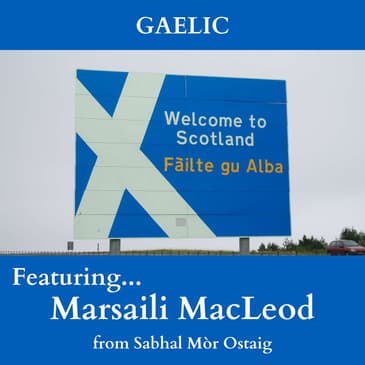
Gaelic is the founding language of Scotland and, for a long time, its dominant language. After suffering a significant decline in usage over the last few centuries it's back on the upswing. What is this language? How is it being taught? What is the future of Gaelic?
We talk to Dr. Marsaili MacLeod from Sabhal Mòr Ostaig – the National Centre for Gaelic Language and Culture - to learn more. In this episode we cover:
- The history of Sabhal Mòr Ostaig
- The differences between Gaelic, Scots and Irish Gaelic
- Scotland's approach to teaching Gaelic
- Ways you might learn the language from Canada or the United States
Have thoughts? Connect with 63 Percent Scottish on Twitter, Facebook or Instagram or contact us at 63percentscottish.com.
Music by RomanSenykMusic from Pixabay.
[00:00:00] This is 63 Percent Scottish, a Scotland Appreciation Podcast.
[00:00:30] A Scotland Language Spoken Scotland Today and more than 170 Global Languages from Arabic to Hebrew to Mandarin are spoken across the country.
[00:00:39] That makes Scotland much like Canada or the United States. However, there are two languages that are unique to Scotland, well, uniquely Scottish,
[00:00:46] and those are Scots in Gaelic. The latter, Gaelic, is an ancient language that has considered the founding language of Scotland,
[00:00:54] the dominant language of Scotland, despite a decline in use from its absolute apex,
[00:01:01] Gaelic is still spoken throughout the country, and especially in the Highlands and Islands.
[00:01:05] It has also experienced a Renaissance in recent years, a renewed popularity that has led to Gaelic being much more common across the country than it has been in decades.
[00:01:15] What is this language? Where is it come from? How is it being taught? How is it being integrated into communities?
[00:01:22] What is the future of the language? How might you learn a bit? These are all worthy questions. I found someone exceptional to answer them.
[00:01:31] Now, I'm staring at your name and I'm just going to do it. I'm going to do it. I promise.
[00:01:36] Dr. Marseille McLeod is the vice principal. I'm getting a thumbs up for anyone listening at home.
[00:01:42] Is the vice principal and director of studies at, and I'm sorry for mispronouncing this?
[00:01:48] Sob, sob, sob all more, or stag? How close am I?
[00:01:51] Pretty close, so melodic.
[00:01:55] Okay, I'm not even going to, that's the last time you'll hear me try to say those words.
[00:02:00] Which is the BBC Assures Me, the National Center for Gaelic Language and Culture.
[00:02:04] Dr. McLeod is a specialist in language revitalization, the teaching and learning of Gaelic and minority language policy and planning.
[00:02:12] She was also a member of the National Research Network for the Preservation and Revitalization of Gaelic from 2011 to 2018,
[00:02:19] and the co-ed or of Scottish Gaelic studies for four years. It would quite honestly be impossible to find someone more qualified to talk about Gaelic,
[00:02:27] and so thank you Dr. McLeod for joining me.
[00:02:30] Thank you for inviting me.
[00:02:32] So I said that I was not going to try and pronounce this again, so I will not do it.
[00:02:37] I don't want to, it's like a punishment for anyone listening at home.
[00:02:42] Let's start with the National Center for Gaelic Language and Culture.
[00:02:46] And your involvement with it. You tell us how you came to say Gaelic in the first place, and then maybe a bit about this center itself?
[00:02:53] Indeed. Well, Gaelic was in my family. It was the first language of my grandfather or my father's site,
[00:02:59] and I grew up with some Gaelic at home.
[00:03:02] And we had the benefit of learning some Gaelic at school, but it is my second language, my first language English.
[00:03:09] So like many of my vintage, I've learned the language.
[00:03:14] And when I was growing up, Gaelic was all of that in me in many respects.
[00:03:19] We sang in Gaelic, we knew all about Gaelic, language and culture, but it wasn't valued as a spoken language by my grandfather's generation.
[00:03:30] And indeed, I didn't even know that some of my neighbors were first language speakers as a child growing up.
[00:03:35] So like many of the things I've learned Gaelic, and I've learned mainly in adulthood.
[00:03:42] And mainly through somirostig, the National Center for Gaelic Language and Culture, where I had the good fortune of becoming a PhD student,
[00:03:51] while registered at the University of Aberdeen.
[00:03:54] And whilst a PhD student, I had the opportunity to register for somirostig's online distance learning course called and keep course in theory or access course.
[00:04:09] And really it was then I started getting serious about learning what I considered to be my language and language of my people and my community.
[00:04:16] So that was some years ago. I started and cruised to indigely, I think, in 2004.
[00:04:24] And six years ago, I had the privilege of applying for the position of the director of studies and vice principal, somirostig.
[00:04:32] And as you and your listeners can well imagine, when I started on my learning journey in 2004, little did I realize that one day I would play a part in this very important institution.
[00:04:45] Yeah, that's all a bunch of that surprises me. I would have guessed that like Kenyak for instance, you know, he was an native Gaelic speaker.
[00:04:55] He was not, you know, English was his second language. So it kind of surprises me that you're in the position you're in, but as someone who has learned it as their second language.
[00:05:04] It surprises myself. So to find myself in this position, and it's a privilege and it's a responsibility.
[00:05:13] So when I grew up, language shift was quite profound.
[00:05:17] So unlike an island's reconniquity of the cloud is from where the language is still the first language of people, you know, people's day.
[00:05:25] The language shift was so pronounced in north by southern and archaic and J. If I'm from that people were ashamed of the language. It wasn't an language that was spoken.
[00:05:36] It had been very much relegated. People were worried that if you like taught Gaelic to your children, that you would then take away their capacity to speak English, that would affect your job chances.
[00:05:46] People were aspirational. They wanted their children to do well, and Gaelic was old-fashioned. It was something that was no longer spoken.
[00:05:56] And there was also the case of migration into the areas, for example my, or one example of my family, that my grandfather, my the non-Gaelic speaker.
[00:06:07] So there was more movement in the population, and therefore non-Gaelic speakers were introduced. And as I see language shifts was more pronounced.
[00:06:15] So I'm what many would call a head at a language learner, and that's sort of third generation of coming back to the language.
[00:06:24] But I work at the National Center, Psalmurostique with many first language speakers, native speakers and those of learned the language.
[00:06:34] And that's pretty typical now of institutions in Scotland today, and indeed those who grew up with Gaelic in the home, many of them continue to learn the language because Gaelic has been minority to such an extent, that they may not be used to using Gaelic and all aspects of their lives.
[00:06:51] So for example, many might feel comfortable speaking formally in Gaelic and having the laugh in Gaelic, but they wouldn't be necessarily comfortable using the language professionally in the workplace.
[00:07:02] For example, because of its minority language situation, we have a whole range of skills amongst our speaker population.
[00:07:14] And let's listen.
[00:07:16] And you're kind of journey to becoming fluent. I think maybe, I'd imagine would give you a really great appreciation for the challenges of learning it, learning that language and also how to help people could be introduced to it more than they happen.
[00:07:33] Indeed, indeed, I think so. I understand the challenges at learners' face.
[00:07:41] I think because I have been a learner and come through high education system to some degree, I'm a good learner, but also to community classes and adult learning in a form of way, I've done a lot of that myself.
[00:07:52] I understand that picture very well and I think, I hope. I hope that I act as an inspiration to many learners who adult learners and those younger, who perhaps don't have the confidence or haven't had the confidence, I think they might become fluent Gaelic speakers.
[00:08:12] And that's something that's been prevalent among the adult learning community in Scotland over the last 50 years. People have, haven't aspired to become fluent because many of them didn't think they could.
[00:08:23] They weren't the structures in place, they weren't the learning path we necessarily historically.
[00:08:27] And there weren't many examples of your average person learning Gaelic and becoming bilingual.
[00:08:36] Very much, although you refer to the language as spoken in Scotland, we're very much a monolingual nation today.
[00:08:42] And so bilingualism is quite unusual in Scotland, and there's still this notion, this notion of sub-chart to bilingualism that is that you learn a second language, it'll take away from your other language.
[00:08:52] We've had to sort of come to that. So I hope that people like me, you know, motivate other people to say, yeah, I can develop my skills.
[00:09:02] I can become more fluent in the language and institutions like Summer, Austin and others in Scotland now provide lots of ways to learn Gaelic and to become a very active member of the Gaelic community.
[00:09:13] So for those uninformed listeners or podcast hosts, could you spell out the difference between Scott and Gaelic? I know that there are two different languages, but I don't know what separates them and why they're two different languages.
[00:09:26] Indeed, so Scottish Gaelic, along with Irish and monks from the Laman, there are members of the Gaelic branch of the Celtic languages.
[00:09:35] So the Celtic language has also included the Britonic languages of Welsh, Cornish and Britain.
[00:09:43] So Scottish Gaelic has descended from Middle-IDish, so the Irish language in Ireland.
[00:09:50] And so it only evolved as a distinct variety around the 12th century.
[00:09:53] But a Scott is a branch of the Germanic family of languages, which includes Dutch, English, and Friesian.
[00:10:02] And so Scots is directly descended from Northern English.
[00:10:06] So there are two separate language families.
[00:10:09] And Scots today is a collective term for the Scottish dialects, and that includes dialects such as Lallons and the LoLons of Scotland,
[00:10:18] and the Shetland Islands, and North, and North East Scotland, and so on.
[00:10:24] So they're quite distinct languages.
[00:10:27] And when I was speaking, can you talk about Gaelic and Irish, Irish Gaelic or Irish Gaelic?
[00:10:38] I would say Irish Gaelic, but yeah interchangeable.
[00:10:43] They're spelled the same way.
[00:10:46] But are the differences, so he suggested the difference was substantial enough that he would have a hard time maintaining a conversation.
[00:10:54] Is that true?
[00:10:56] Is that just due to the time that is passed?
[00:10:59] Indeed, as I was saying earlier, Scott's Gaelic emerged as a distinct variety of Irish from 12th century.
[00:11:06] So there's been a long time since the same language.
[00:11:11] So one might say there are similar but different.
[00:11:15] And there's a lot of a cavity that's recognisably similar,
[00:11:19] but the spelling systems evolved, the different meanings evolved,
[00:11:24] there are grammatical differences, signs of change, pronunciation.
[00:11:29] So the languages have grown apart in that respect,
[00:11:32] but there are dialectal variations, so there's some dialects in Ireland such as the dialect and donny goal,
[00:11:40] which is really close to the dialect of our Gael, which is geographically the closest to it.
[00:11:45] And also Gaelic, also close to the language for the name from in northwest Scotland, up in Dhehikki.
[00:11:54] So there are some dialects that are closer than others.
[00:11:57] But yeah, different, just grown apart over these years.
[00:12:02] So for example, in Ireland, they have the date of case as fallen to misuse,
[00:12:07] whereas in Scotland we still use the date of case.
[00:12:12] And you might, for example, see in West Coast of Ireland there were poor suck,
[00:12:16] it mean exhausted, tired, fatigued, but if you said in Scottish Gaelic,
[00:12:21] poor suck, somebody would think you're highly depressed.
[00:12:24] So there's that divergence of meaning as well.
[00:12:27] But often it just takes a little bit of understanding,
[00:12:32] particularly to be able to read the written form of Irish,
[00:12:36] and Gaelic's because we're able to read Irish,
[00:12:38] or it's certainly'll get the just because that but core vocabulary is still the same.
[00:12:42] It's just understanding how this spelling systems have a diverged, for example.
[00:12:47] Yeah, it just kind of, I found it tickled me to think of the idea that he would have a tough time having that conversation.
[00:12:56] It would be harder to have that conversation, but he also described having a conversation with people and Cape Breton in Canada.
[00:13:03] It's not with no problems whatsoever, but it's again, that's those are people from Scotland
[00:13:09] and bringing the language over a couple hundred years like that.
[00:13:12] That's right.
[00:13:14] Yeah, that's right.
[00:13:14] And I think it just takes your ear to tune in to some of the Irish and vice versa.
[00:13:21] So you'll find that over a few points of Guinness, you'll become much more fluent in Irish.
[00:13:26] And it'll be no problem at all, and you'll be mutual intelligible when another, you know?
[00:13:30] So it just depends, I think you just have to, but initially it can seem really quite different.
[00:13:36] Was I right to say that Gaelic was the dominant language in Scotland?
[00:13:39] When did it start losing ground English?
[00:13:42] Indeed, you were right. Gaelic was the dominant language in Scotland around the 11th century
[00:13:46] and it was from the 11th century onwards, the Scots language displaced, Scots Gaelic.
[00:13:53] And so we understand from historical records and research that it was around the 14th century
[00:13:59] that the Gael Talk region emerged as a distinct Gaelic speaking region and conscious to the Scots Lowland area,
[00:14:07] which was called in Gaelic, the Gael Talk.
[00:14:10] And so it was around 14th century that Scots Lammers became the spoken tongue and indeed it became the dominant language of Scotland.
[00:14:22] I understand that for example by the end of the 17th century but 70% of the country spoke Scots
[00:14:30] and the remainder Gaelic in the root and the rural parts of the Highlands L Islands.
[00:14:35] And that Highland border still exists, the Gael Talk border but if you like it's been moving north and west since the mid 14th century.
[00:14:44] So Gaelic is very far from extinct, unlike Pictus which is another Scots English which I haven't mentioned and won't mention again
[00:14:52] but it has certainly required some intervention and it's interesting to me because in Canada we all learn French
[00:15:01] or Italy we all learn French until our ninth year of schooling.
[00:15:07] And so I'm kind of interested in knowing how Scotland has integrated Gaelic into schooling.
[00:15:14] Indeed so we've just had the latest census figures released from the census taken in 2022
[00:15:21] and that confirmed that 69,700 people could speak Gaelic.
[00:15:27] So that's an intercental increase of 21% since the last census in 2011 and indeed it's the first growth
[00:15:34] and the number of Gaelic speakers since the first census was recorded in 1891.
[00:15:40] Other I should add than I we spike in 71 but that was because of a change in question.
[00:15:45] It wasn't thought to be a genuine increase in the number of speakers.
[00:15:50] People didn't suddenly start speaking.
[00:15:51] No, not in the 70s and indeed Gaelic has recognized as being banished from the school system.
[00:15:57] So the formal state system did little to support Gaelic.
[00:16:01] In fact it contributed to its memorabilitation throughout the 19th and 20th centuries
[00:16:06] and it was only in 1980s when we introduced any sense of a Gaelic education into the school system.
[00:16:15] There had been a little bit in the 60s onwards when there was a requirement to law for Gaelic pupils.
[00:16:25] And Gaelic speaking, people also Gaelic speakers to receive some education and Gaelic.
[00:16:29] So that notion of it at the right to receive some Gaelic education.
[00:16:34] So that was supporting those who spot Gaelic to become literate etc in the language.
[00:16:38] But we only introduced Gaelic education to our system as through what's known today is Gaelic.
[00:16:45] Meege education in the 1980s and that was with two schools in 1985.
[00:16:51] So we opened with two primary schools teaching 24 pupils in 1985.
[00:16:56] One of the schools in the University of England last school.
[00:16:59] And that's grown now to 61 schools teaching nearly 4,000 pupils across Scotland today at the primary school level.
[00:17:07] And primary for ourselves means people's age usually between 5 and 11.
[00:17:13] But yet, it took to the 80s before we actually started a nation supporting Gaelic midgeum education
[00:17:20] and that's been very much an immersion model.
[00:17:23] So it typically and still still the case but certainly started us.
[00:17:29] Jewel, Jewel, Stium schools where you'd have the Gaelic class and the English class and you'd have Gaelic immersion education
[00:17:35] in the Gaelic class, right through your primary schooling and the aim has been always to support people
[00:17:42] to become equally fluent in Gaelic and English by the time you leave that school and go on to their high school
[00:17:48] or secondary schooling age 12 onwards.
[00:17:52] So it's quite a recent development and Gaelic midgeum education has been hugely successful in Scotland
[00:17:59] and has extended into the secondary schools.
[00:18:03] But there's a lot more to be done.
[00:18:06] So the drop-off from, you know, is quite significant.
[00:18:10] So I mentioned that we had some 4,000 pupils going through Gaelic midgeum education in primary
[00:18:14] but only 1,600 or going through Gaelic midgeum and secondary.
[00:18:19] It's secondary school level and that's children who can access subjects through the midgeum of Gaelic
[00:18:24] as well as in Gaelic as a subject and itself and developing the language skills.
[00:18:30] So one of the important aims of national language policy today is to support the growth of Gaelic education at all levels.
[00:18:40] And that includes early years, we have good early years provision in primary school, then secondary school and then post school education
[00:18:47] and that's what summer all stake does principally.
[00:18:50] It's post school education through the midgeum of Gaelic and Gaelic midgeum immersive environment.
[00:18:57] Okay, there are a lot of parallels with how French is taught here.
[00:19:02] I think in everything you've described including the fact that I think that opportunities for learning French decline substantially in secondary here.
[00:19:14] That it's in primary, you have French classes for everyone.
[00:19:20] You have French immersion in English speaking schools for certain students and then you have totally French schools.
[00:19:30] But then once you get to post or a second area, I think it kind of drops off and it's harder to find those opportunities.
[00:19:37] Yeah, it's interesting. I think the difference is that we don't have such a serious education model as yourself.
[00:19:46] So in terms of the number of local authorities, there are 32 local authorities in Scotland.
[00:19:54] But only a proportion of them are offering, I think 16 are offering Gaelic midgeum education and we've only recently introduced dedicated Gaelic schools.
[00:20:08] And that's been a really positive development because one of the main challenges for ourselves has been encouraging children to use Gaelic in the playground if you like informal amongst themselves.
[00:20:20] And when they were in dual language schools, often, they were to English, the majority language when they leave the classroom.
[00:20:27] So for lots of school events and the playground or sports.
[00:20:33] And the model we've developed now for dedicated Gaelic schools has been really successful. We've got a really good example of dedicated Gaelic,
[00:20:42] like primary school and poetry in the island of sky, which is where I live.
[00:20:47] And we've got an example of in Glasgow Gaelic school, which offers education from the early years right up to age 18 through the midgeum of Gaelic.
[00:20:56] And that's been a really positive model but what we do not have is Gaelic lessons for all pupils in all schools.
[00:21:02] And the there are, there is provision for learners. We'll get a class or two week in the school but it's not. It's not required part of the curriculum for example.
[00:21:15] Yeah I think certainly where I'm from in Ontario, I think there's a there is a political element to it as well as.
[00:21:23] And I think that's a big difference in Canada is just with with a large province like Quebec, there's French speaking and our federal public service is very much bilingual as well.
[00:21:36] So opportunities for you know employment in federal public service really come down to your ability to speak French in many cases.
[00:21:43] And so there are those kinds of differences. I think it's just more they said almost the political driver is a reason why it's but it's it's way more available.
[00:21:53] Yeah, it's very it's very available and but so it's one thing to teach Gaelic to school children but bringing it into active use in the broader communities a bigger and different challenge.
[00:22:04] What is Scotland doing to bridge the gap between the classroom and the community?
[00:22:07] I think that's a really good question and it's one that we're all very concerned with because as I said often it's been the case that children have seen Gaelic as a school language or something to do in school but not something to do outside of school.
[00:22:22] And that's particularly the case where we've got so many children and schools learning Gaelic actions are second language they don't necessarily have it in the home.
[00:22:31] Inals or they have some Gaelic in the home but it might be bilingual homes. So we have a range of organizations that work to support the Gaelic communities and often these communities are based around the schools.
[00:22:45] We've got a network of static and of use of clubs and Croylican sort of out of our out of school care for children and an organization coming to Gaelic dedicated support in the Gaelic and the home, the family and the neighborhood.
[00:22:59] And they work with a range of different kind of projects and initiatives.
[00:23:03] And one of those is supporting, if you like, animators or Gaelic development officers to work at a local level to run activities through the medium of Gaelic.
[00:23:13] I think supporting parents to keep on using Gaelic at home is really important that's a family language support because a lot of parents start using Gaelic with a children's a first language and their children reply in English.
[00:23:28] Because they've got a lot of access to obviously English language, media and English, a dominant language.
[00:23:34] And it's quite hard to counter that and keep using Gaelic until, you know, such time as the child will reply in Gaelic and use Gaelic themselves.
[00:23:45] So it takes quite a lot of persistence and dedication by parents and families to do that.
[00:23:49] And it really helps when there are structures that support the families, particularly with younger children to maintain that sort of really rich Gaelic environment.
[00:24:00] We've just said farewell to 100 children, that's almost all my loss to this week where we've had Gaelic family learning week, shagging into luck.
[00:24:09] And that's been wonderful. We've had about 150 people on our campus here in Skai and it's a chance for parents and children to come together and stay at the college.
[00:24:20] And the children go and get the range of activities and drama and arts and sports, lots of fun things for the week.
[00:24:26] And the parents come into classes and the second language learners mainly and they're learning Gaelic.
[00:24:33] And while the children are in their own activities and then everyone comes together at night.
[00:24:38] And these kind of initiatives are really important for supporting lots of parents to support their children with their Gaelic schooling.
[00:24:47] And we also have a range of sort of national sort of sporting kind of initiatives, so for example,
[00:24:53] a Gaelic football team, Gaelic initiative supporting Shanti and we've got an organization called Sports Gallic, which organized lots of outdoor activities for children from the region of Gaelic.
[00:25:07] And there's a big emphasis here on arts organizations as well.
[00:25:11] So the fashion movement was established, I think in the early 1980s around the same time as Gaelic medium schooling was set up,
[00:25:20] and Fesian and Gael was established, and it's a whole network of arts organizations that support music.
[00:25:31] And to additional Gaelic music but also there's a strong element of Gaelic language learning through the Fesian network.
[00:25:38] So these things have been really important as have establishing national cultural sporting education events that increase the status of Gaelic and the eyes of children and the warden.
[00:25:50] For using Gaelic, so for example we've got an annual short film competition called Film G and Children's Submit their Films.
[00:25:59] And there's a big, it's a little bit like the Oscars for Gaelic and you know the children get very glamour, but go down to the go to Glasgow for the event and you know there's a national debating event as well.
[00:26:20] And more national the real and that happens every year.
[00:26:25] And it's a really, it's a great opportunity for children and adults to participate in soul,
[00:26:33] and to use it competitions and to celebrate Gaelic and the Gaeles and the rich culture and traditions that we enjoy.
[00:26:43] So these are the kind of things that are taking place to support the use of Gaelic and the normalization of Gaelic outside the school.
[00:26:54] And again the work police and the national language planning framework is really making a big difference.
[00:27:02] So we only passed the Gaelic language act in 2005 at places of requirement and all public organizations to develop Gaelic language plans.
[00:27:09] And it means now we've got a lot more organizations that you can use Gaelic to access public services more.
[00:27:16] Gaelic's much more visible as a result of these, these plans and yeah more opportunities to use Gaelic than then have been in the past.
[00:27:27] So it sounds like you're optimistic about the future of language.
[00:27:31] Indeed I think it's my job to be optimistic.
[00:27:34] Absolutely, I always you know it's quite easy to feel pessimistic because despite the increased support in Scotland for Gaelic and service national service tell us that we know there's more support than there's been for years for Gaelic.
[00:27:49] It's still a challenge because we know that because of the we the world as today that it's a challenge to maintain minority languages it's a challenge to develop fluency and bilingualism.
[00:28:05] In what the still as I said, still our monolingolation, the many respects.
[00:28:10] So are dominantly monolingol. So it is a challenge because we know that the number of speakers in the islands has declined yet again and the base of the census figures we know that it's not unexpected.
[00:28:23] I think it's just that the nature of Gaelic and how we use Gaelic as a community is changing and social media has a big influence in that.
[00:28:31] We're much more network, more mobile than ever before.
[00:28:35] But I feel optimistic because I work and an amazing organization and we had last year, 1,600 students come and study with us in some capacity.
[00:28:45] And only a small proportion of them are residential and stay into high education course, but I see these students d and d out.
[00:28:53] And they give me a huge sense of optimism because their confidence, their pride, their capable and they themselves are against change makers for the language.
[00:29:03] Our students and our graduates at Sormol Austin go on to have a major influence when they go on to graduate and enter the world of work or the communities where they live and they work.
[00:29:15] And so I'm huge optimistic when I when I interact with any of our students.
[00:29:21] And yeah, I'm optimistic with the language but I recognize that everyone does that how we use the language and the community which use languages is ever changing and I think that's just natural.
[00:29:38] For any language and today's society that and these languages have to evolve and will be used in different ways.
[00:29:45] But the main thing is, I mean, we keep celebrating, the membering, learning, enjoy, enjoy the community that we have and yeah and continue to to celebrate that community.
[00:29:59] If listeners to this podcast are interested in learning, garlic or at least exploring it, how should they go about that?
[00:30:05] I mean, it's on dual-lingo would you recommend that program.
[00:30:08] I think dual-ingos are really good place to start, so I'm going to ask you to like it to partnership with dual-ingo and it gives you a really good basis but there's a lot of learning opportunities now for garlic online and digital resources.
[00:30:22] So I would recommend any listeners visit www.gallickcollege.edu to find out about the garlic college in some and novel schoolcia where they offer online and in person learning.
[00:30:36] I think I'm going to visit, it's on the lost dig online www.smll.uichii.ac.uk and again, some lost dig provides online distance learning, it provides online short courses and in person learning here in Nilesky.
[00:30:51] And then encourage listeners to visit www.speakgallick.scot which is a new national initiative, it's a digital learning resource online.
[00:31:01] Lots of materials, so almost because I've played to be the academic partner for this national initiative and it's going to be lots of materials, podcasts,
[00:31:13] a classroom materials, videos, etc. you can go online and find out about classes and find lots of resources to help you with your learning
[00:31:25] and that's all organized according to the CFR, you know the common you're being framework for languages who start at level E1 and you work QA up.
[00:31:34] So there's lots of ways to learn garlic and it's a very international community today and if you go online and you can find video same.
[00:31:46] That works on Facebook for example, of garlic people using garlic and then as you should see that's some elastic whilst based in that island sky and Scotland.
[00:31:56] It's also international we have over 25 countries represented in terms of a student cohort is academic year so that means that there'll be a garlic speaker living near you.
[00:32:08] There's lots of garlic speakers in North America, lots of networks to be explored and connections to be made.
[00:32:16] Alright thank you so much for joining us Dr. McLeod for those interested in the work of the National Center for Garlic Language and Culture.
[00:32:25] Yes I'm avoiding any future pronunciation blunders. We'll share links in the show notes but also share the links for all the links that you just mentioned as well in the show notes because I think those should all be very accessible.
[00:32:37] How do we say goodbye in garlic Dr. McLeod?
[00:32:41] Thank you very much, you can say goodbye in many ways but when was common ways would be Martian life.
[00:33:12] If you find cast including the Toronto Sandress Society, this Scottish Society of Ottawa, the Scottish Banner and Scottish Studies at the University of Welf.
[00:33:21] Your support has never taken for granted. Until next time, goodbye.